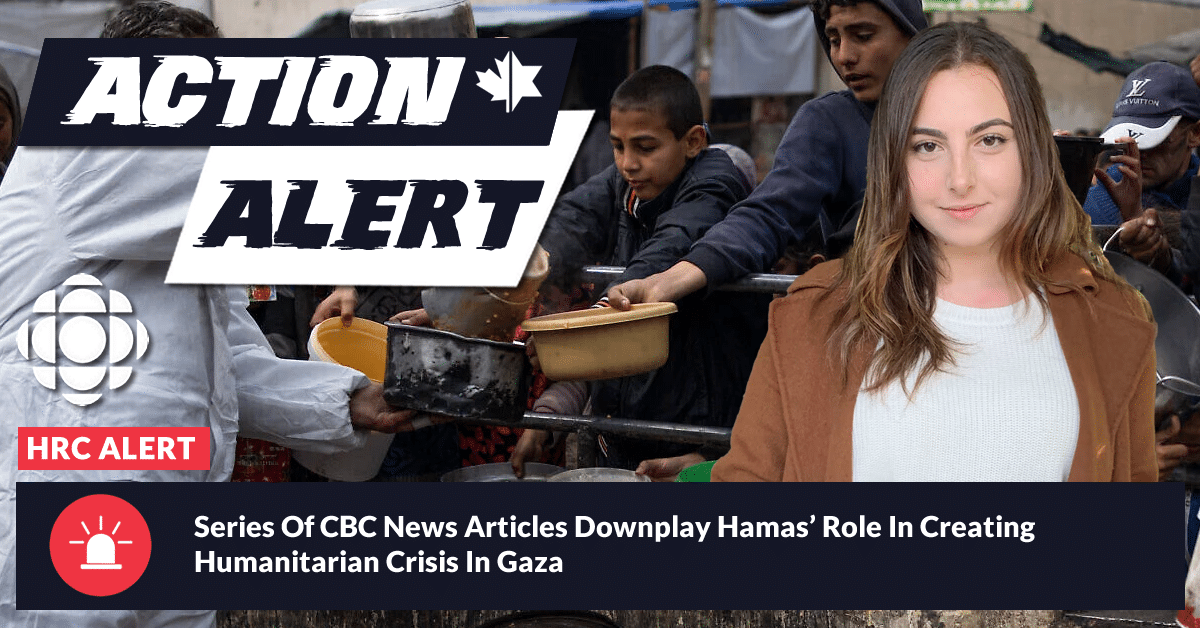
Sara Jabakhanji, who signed a 2021 open letter calling for more anti-Israel news coverage, continues to help fulfill that demand in her capacity as a senior writer for CBC News.
Her May 26 article entitled: “Girl, 5, survives fiery aftermath of deadly Israeli strike on Gaza City school shelter,” is just the latest report which focuses virtually exclusively on Gazan suffering, overlooking the plight of Israeli hostages being kept in Gaza, and the ultimate responsibility of Hamas for the conflict.
The story focused on Ward Al-Sheikh Khalil, a young Gazan girl who was outside a building that was struck by an Israeli airstrike, a video of which went viral. While Jabakhanhi did mention that Israel says the building in question was being used by Hamas and Palestinian Islamic Jihad (PIJ), and that Jerusalem took steps to avoid harming civilians, those brief acknowledgements are swallowed up by the sheer amount of words spent sharing alleged details from the strike from the perspective of Gazans.
The following day, Jabakhanji authored another article entitled: “How will Gaza aid distribution work under controversial U.S.-backed group? Here’s what we know,” which zeroed in on the Gaza Humanitarian Foundation (GHF), a joint Israeli/American humanitarian operation inside the territory. She noted the criticisms of GHF from other groups, including claims from the United Nations that it will “weaponize aid.”
She mentioned allegations of impending “famine” in Gaza, yet made no mention of any countering data, including evidence of widespread food inside the enclave and the large amount of humanitarian aid inside Gaza.
A June 3 article by Jabakhanji entitled: “More than two dozen Palestinians killed as IDF fires on people it says left approved route to aid site,” quoted so-called “health officials” as saying 27 Palestinians were killed by Israeli fire near a food distribution centre, though she paraphrased Israel as saying that its soldiers fired on a threat, though “it was still investigating.”
However, the vast majority of the article focused on claims of incidents related to food distribution in Gaza, largely overlooking the extent to which Hamas has so successfully weaponized humanitarian aid in Gaza, both by stealing much of it, and by threatening Gazans who try and take aid from Gaza Humanitarian Foundation (GHF) sites, and in fact, just days after her article, Hamas terrorists murdered five Gazan aid workers.
While that incident came after her article, Jabakhanji’s report gave heavy emphasis to anti-Israel groups like the United Nations, assailing Israel’s aid efforts, and sanitizing their own failures.
On June 6, Jabakhanji authored another article entitled: “Israel ‘operated clans’ in Gaza, Netanyahu says, after being accused of arming Palestinian militias,” which she co-authored with fellow writer Yasmine Hassan. The article quoted the United Nations as claiming that “most of Gaza’s 2.3 million population is at risk of famine after an 11-week Israeli blockade.” No mention was made of the huge amount of aid that came into Gaza immediately preceding that blockade, amounting to about five months’ worth of food, nor was there any acknowledgement of the mountain of data indicating that by no reasonable metric is there a shortage of food inside Gaza, according to experts.
The authors said that “hospital officials” had claimed “more than 80 people had been shot dead (by Israel)…near distribution points between June 1 and 3,” though they did not share that Israel strenuously denies that its soldiers were anywhere near reports of shots fired on June 1, an enormously significant detail that for unknown reasons went unmentioned.
Sara Jabakhanji’s reporting consistently echoes anti-Israel narratives, giving disproportionate weight to Gazan claims while minimizing crucial context about Hamas’ role in the conflict and Israel’s humanitarian efforts.