

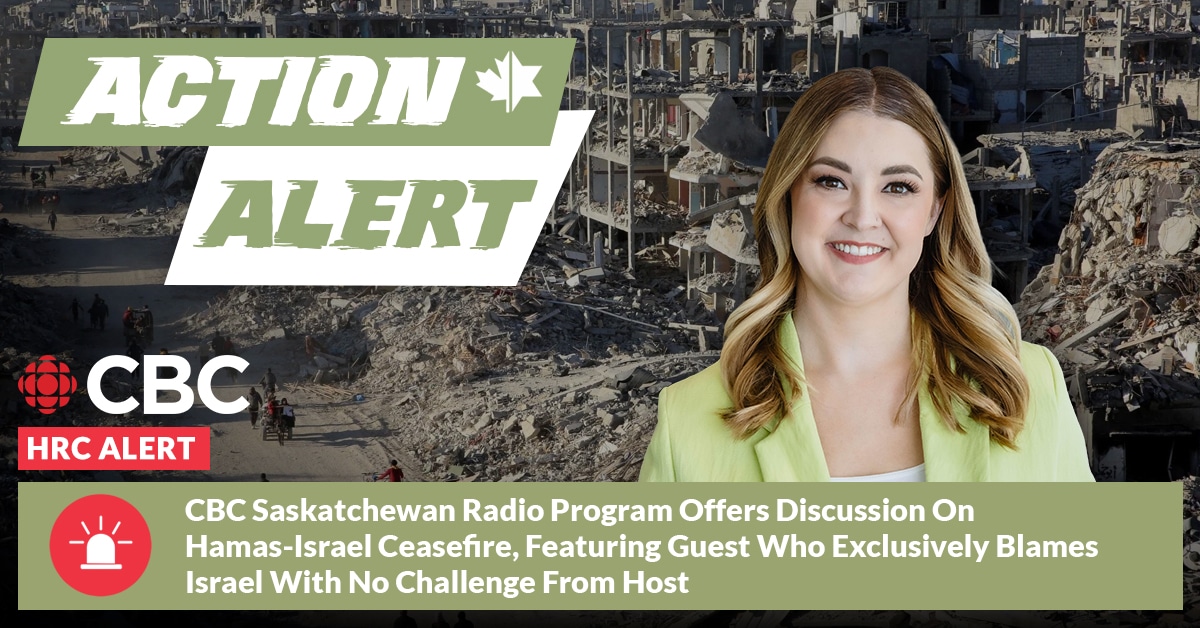
A recent CBC radio program, ostensibly about the situation in Gaza following a ceasefire agreement between Israel and Hamas, missed the forest for the trees.
On the January 16 episode of Saskatoon Morning, host Stephanie Massicotte interviewed Colleen Bell, described as “an international relations expert specializing in war and security at the University of Saskatchewan.”
The interview entitled: “Deal between Israel and Hamas to pause the 15-month war in Gaza is on hold,” was conducted in anticipation of the now-active ceasefire deal between Israel and Hamas in the Gaza Strip. Bell was interviewed about her perspective on the situation in Gaza moving forward and the circumstances around the ceasefire agreement.
Click below to listen to the full segment:
Firstly, in her description of the ceasefire deal, Massicotte grouped the Israeli hostages with the Palestinian prisoners being released as “Israeli and Palestinian hostages.” This grotesque and false equivalency between largely civilians taken hostage from Israel and held in Gaza — in tunnels, in civilian homes and infrastructure, tortured and starved — and Palestinians arrested and held in Israeli prisons for crimes, often violent and murderous terrorist attacks, represented the beginning of a pattern of seemingly deliberate misrepresentation throughout the interview, one that downplayed Hamas’ brutality while casting Israel as the primary aggressor.
The two initiated a discussion about the obstacles in place that could prevent the ceasefire from going through; despite feeling “hopeful,” Bell elaborated on how Israeli Prime Minister Netanyahu and other Israeli politicians might prevent the deal from happening. She also blamed the United States, and specifically U.S. President Trump for what she described as allowing “Netanyahu…[to] resume bombing if they wish.” Bell explained that “there are concerns that both the United States and Israel are not entirely committed to this deal,” and explained that while Netanyahu has accused Hamas of holding back on certain parts of the agreement, “Hamas has indicated that they are committed to the agreement.”
Why Hamas’ words are sacrosanct in Bell’s eyes is anyone’s guess, but this unfounded statement received no challenge from the host.
That Bell took Hamas’ word as truth is certainly concerning enough as it stands, but when elaborating on what she believed to be concerns about the longevity of the deal, Bell took the opportunity to ignore Hamas and entirely blame Israel.
In Bell’s explanation of “the underlying issues to why there is a war remain unresolved,” Hamas and Palestinian terrorism in the name of the destruction of Israel were not mentioned at all. Instead, she pinned the blame on “the continuation of the occupation of the Palestinian Territories,” and more broadly, Israel’s supposed refusal of a two-state solution.
Massicotte said nothing to refute or push back on Bell’s claims, choosing to pivot to the “conditions in Gaza, especially with winter setting in.” And while there is no problem in reporting on the humanitarian situation in Gaza, ignoring Hamas (and other Palestinian terrorist groups) and downplaying its ongoing crimes, especially its role in both initiating and perpetuating the war.
Bell, for example, cited the casualty numbers in Gaza provided by the Hamas-run health ministry that does not distinguish between civilians and militants, and lamented that “there is pretty much no functioning infrastructure in the country.” Without mentioning that Hamas utilizes its own people as human shields and civilian infrastructure for terrorist activity, Bell painted a picture of Israel as entirely culpable for anything and everything happening in Gaza.
When asked “Is there a realistic path toward broader stability in the region?” Bell elaborated that “the biggest obstacle right now to having real discussions about a political settlement is the United States’ support for Israel to kind of do what it likes.”
This ongoing pattern of ignoring Palestinian terrorism — rooted in the jihadist desire to destroy the State of Israel as the Jewish national home — while simultaneously propping up the “Palestinian state” question as solely Israel’s fault is part of a broader effort to obscure the deeper realities of the conflict.
It reflects an unwillingness to acknowledge that a sustainable solution will remain unattainable as long as Palestinian society, driven by jihadist and antisemitic ideologies, refuses to accept Jewish sovereignty in the region. A two-state solution, or any solution, cannot happen if Hamas is treated as a legitimate authority in Gaza rather than a terrorist group that oppresses Israelis and Palestinians alike.
Bell throwing out the “Palestinian state” question alongside repeated efforts to blame and criticize Israel alone doesn’t read as “hopeful.” This is not an analysis rooted in hope for peace, but in a refusal to acknowledge the core ideological barriers preventing it. It reads as someone who ignores the antisemitic indoctrination of Palestinians, the horrific terrorism that Israelis still regularly endure, and the history of the conflict and the region more broadly.
By uncritically allowing such one-sided narratives to go unchallenged, CBC’s Saskatoon Morning’s January 16 segment, hosted by Stephanie Massicotte, contributed to a discourse that distorted the reality on the ground, erasing the complexities of Hamas’ role in sustaining the conflict and reinforcing misleading perceptions of Israel.


