

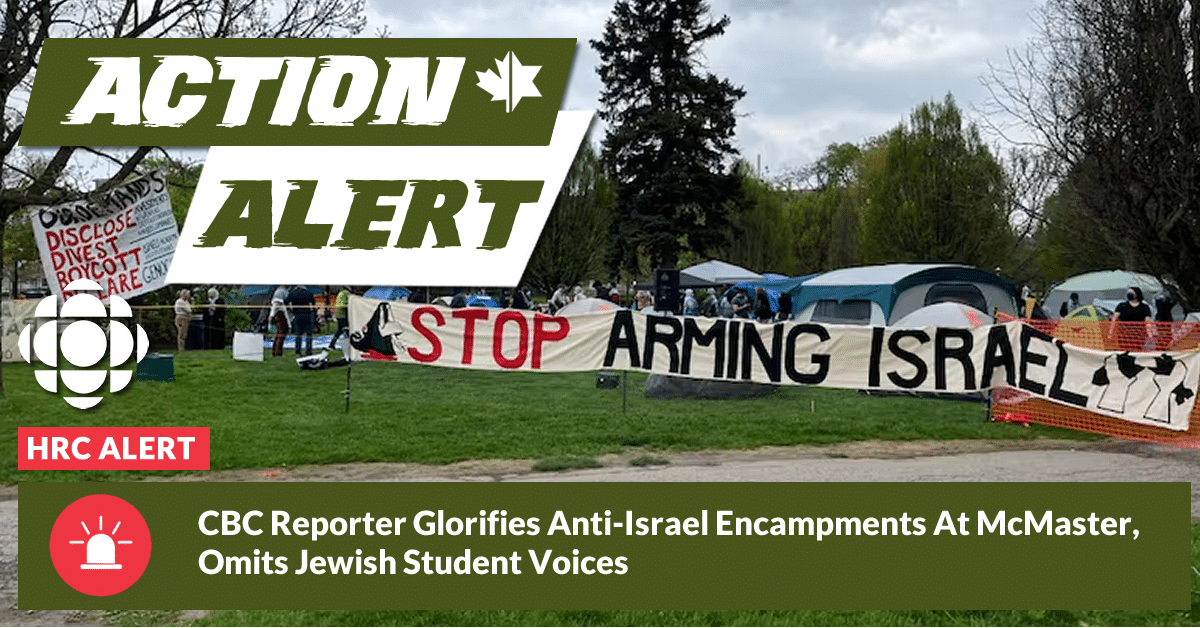
McMaster University ended the anti-Israel encampments that plagued its campus in May, 2024. To mark the anniversary, CBC News published a one-sided article whitewashing the fringe movement behind the campus occupation, amplifying its demands, and slamming the university for not breaking its ties with Israel.
In her article entitled: “1 year on, McMaster says it’s completed nearly all commitments made after pro-Palestinian encampment,” reporter Aura Carreño Rosas began by relaying McMaster’s infusion of $200,000 in new scholarship funding to support Palestinian students.
This funding was one of a number of commitments the university made as part of an agreement to end “pro-Palestine” encampments taking over the campus.
Other commitments included financial disclosure of investments and psychological support for Palestinian students. The university also said it would allow student groups to give a presentation on divestment at a Board of Governors meeting.
One year on, the university has already met most of these commitments. But that didn’t stop Rosas from waxing poetic about the encampments, glorifying the protests, and unquestioningly quoting pro-Hamas talking points. She also failed to provide any counterpoint, such as the extremism widely seen at such anti-Israel campus occupations.
Rosas gave a platform to the unreliable and debunked Hamas Health Ministry statistics. As of May 2024, she wrote: “more than 34,735 Palestinians had been killed.” She then added that “around 1,200 people, mostly Israelis, were also killed in Oct. 7 attacks by Hamas, according to Israeli tallies.”
Rosas’ coverage emphasized Palestinian casualties with zero context. She did not mention Hamas’s use of human shields, its embedding in civilian infrastructure, or Israel’s well-documented efforts to minimize civilian harm. She did not describe the deliberate Hamas atrocities of Oct. 7: rape, torture, child murder, and kidnapping. Nor did she mention the ongoing hostage situation.
Throughout her article, Rosas framed the encampments and protestors in a positive light. She quoted one protestor speaking glowingly of the “energy of community and solidarity.” And she unquestioningly boosted protestor claims both that McMaster’s response has been inadequate and that Israel is the only villain in the region.
Twice, Rosas quoted a protestor using the word “genocide” to describe the situation in Gaza. Rosas not only failed to challenge the term, but also failed to present any dissenting viewpoint. She could have invited a legal expert to explore the complexity of the issue. At the very least, she could have explained that no international body has defined the situation that way.
Rosas mentioned in her article Solidarity for Palestinian Human Rights (SPHR), one of the groups that led the encampments. As part of the May 2024 agreement, SPHR agreed not to disrupt university business. In return, SPHR gave a presentation about divestment at a university Board of Governors meeting. In any other context, that might be called a payoff.
Still, SPHR was unhappy with the board’s response. So in December, violating the agreement, keffiyeh-masked SPHR protestors with red-painted hands overran another Board of Governors meeting. They took over the space bearing signs and confronting board members. As a result, McMaster suspended SPHR.
In her article, Rosas mentions the suspension but downplayed the severity of their disruption. And she cast SPHR as victims, saying that members are now “afraid to speak out,” giving their attempts to gaslight readers an ample platform.
At the same time, Rosas makes no mention of Jewish students on campus and their allies, who have been the targets of such antics. Apparently SPHR activists crashing meetings are the real victims.
Rosas did not interview Jewish or Israeli students. She did not share any official statements from McMaster authorities. By failing to present dissenting voices, Rosas’ narrative implicitly endorsed the protestors’ point of view.
CBC claims to be committed to principles of accuracy, fairness, balance, impartiality and integrity. As a CBC News reporter, Rosas owes readers balanced reporting. That includes multiple perspectives, especially on divisive issues. By leaving out dissenting views and amplifying protestor claims, Rosas reinforced a one-sided narrative. It’s a narrative that vilifies Israel, and which gives uncritical coverage to a marginal group of protesters.


