

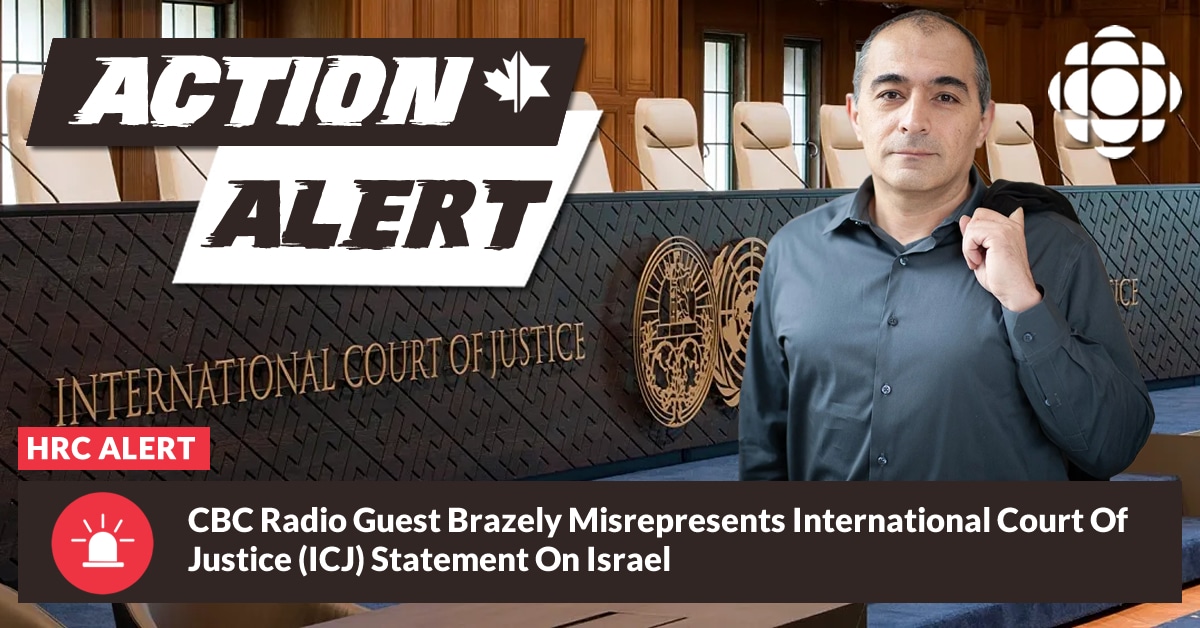
A few problematic comments by Georgetown University Professor Nader Hashemi sullied an otherwise informative conversation about the ongoing geopolitical dynamics of the Middle East during a September 25 segment entitled: “Will the Israeli military actually begin a ground invasion into Lebanon?” on CBC’s Mainstreet Nova Scotia.
Click below to listen to the full segment:
HonestReporting Canada has at times criticized the accuracy of Hashemi’s word choices in the past, and a similar problem emerged about halfway through this discussion as well.
Despite being an expert on current events in the region, Hashemi surprisingly chose to falsely state that “Israel has been plausibly accused of genocide before the world court” — parroting an inaccurate propaganda claim often made by anti-Israel activists. As the International Court of Justice’s (ICJ) former president Joan Donoghue — the person who literally presided over the verdict in question — explicitly told BBC News, the court “did not decide that the claim of genocide was plausible” and that she felt a need for “correcting something that’s often said in the media.”
ICJ Said No Such Thing
This clarification was not surprising to those who actually paid close attention to that case, rather than blindly accepting ideological conjecture and rhetoric about it. South Africa initiated the case accusing Israel of genocide, seeking provisional measures that would force Israel to end its actions in Gaza. In other words, South Africa sought to prove that Israel’s war in Gaza was indeed a genocide that should be ended, rather than the legal and legitimate defensive war that it actually is. The court did not find South Africa’s evidence convincing — because the war in Gaza is a defensive war and Israel doesn’t target civilians. They therefore ruled against demanding an immediate end to the war. This was an embarrassing utter failure for South Africa and supporters of the anti-Israel movement around the world, who had spent weeks insisting that Israel was committing genocide and promising that the ICJ would end it.
Following this humiliating defeat, anti-Israel activists began rewriting history and spinning the reality of what the verdict was in order to manipulate the public and achieve the PR goals they had originally hoped the case would achieve. They latched onto the technical legal terminology of “plausibility,” which in this case refers to the very minimal, hypothetical standard employed to prevent hypothetical wrongdoings in the absence of firm evidence that something illegal was taking place. In other words, in the context of the case, the term “plausible” does not mean that Israel was found guilty of anything, but merely that the court chose to recommend certain safeguards to ensure the continued protection of civilians in light of South Africa’s concerns. Israel has fully complied with the court’s recommendations, which include things like allowing certain levels of humanitarian aid into the Gaza Strip in order to prevent civilian casualties.
The court’s finding that the available evidence did not prove the genocide claim to be true was consistent with what virtually all mainstream institutions with access to the actual facts and evidence have ultimately said upon examination, including the United States government.
It’s unsurprising that Israel-hating agitators purposely use word games to mischaracterize reality to serve their political agenda. But this does not explain why mainstream media organizations are failing to do their homework and correct the record rather than legitimizing misinformation by repeating it. There is no excuse for someone like Hashemi to phrase his point in this misleading manner.
Israelis Support Israel’s Fighting Back Against Hezbollah
It was also concerning to hear Hashemi imply that Israel’s willingness to fight back against Hezbollah terrorism is somehow the fault of domestic politics and the suggestion that “The Israeli prime minister … benefits from escalation.” It’s offensive and unfair to suggest that defending Israel’s civilian population against thousands of rocket attacks is not a legitimate action and duty, but somehow merely a partisan political issue to be analyzed in the context of how it affects Benjamin Netanyahu’s personal political interests. Israelis across the board — including both those who support Netanyahu and those who despise him — believe that confronting Hezbollah’s murderous assaults is the right thing to do.
It would behoove all commentators dealing with this complicated and sensitive subject matter to always do their best to avoid unnecessarily charged, biased, or misleading language when trying to accurately explain the issues to the general public.


