

CBC News reporter Mouhamad Rachini, who has allegedly worn a keffiyeh to the public broadcaster’s newsroom, and who has called supporters of Israel “vile,” is back with another “news report” covering the Israel-Palestinian conflict.
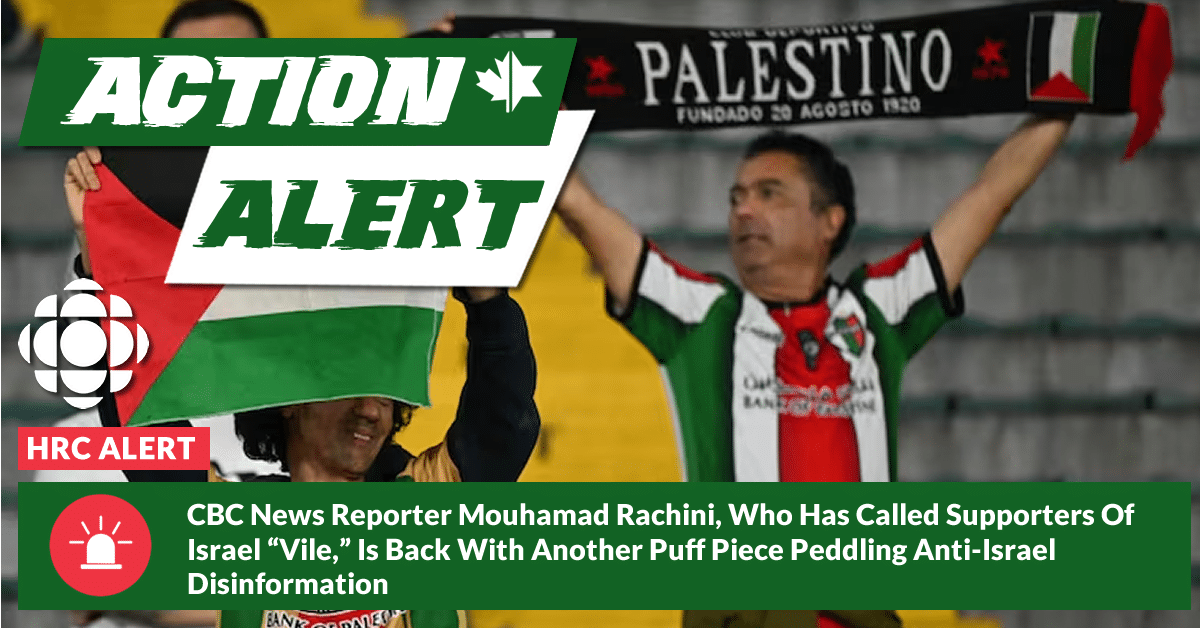
Rachini’s article entitled: “The Chilean soccer team that became a symbol of Palestinian nationalism,” published by CBC News on May 18, offered a sympathetic portrayal of Club Deportivo Palestino, a Chilean soccer team whose identity is closely tied to Palestinian nationalism. Rachini highlighted the club’s strong support from Chile’s large Palestinian diaspora, the largest outside the Arab world, and framed the team as creating a “sense of community” for people identifying with the Palestinian cause. While the article is written in a tone of celebration and cultural solidarity, it suffered from significant historical omissions and presented a one-sided political narrative under the guise of sports coverage.
One of the most problematic aspects of the article is its use of imagery and language that suggest a historical reality that simply did not exist. Rachini wrote that the club’s emblem includes “the map of pre-1948 Palestine,” implying the existence of a sovereign Palestinian state prior to Israel’s independence. In fact, no such sovereign entity ever existed. Prior to 1948, the land in question was part of the British Mandate for Palestine, a colonial administrative region established after World War I, which itself succeeded centuries of Ottoman control. The region known as “Palestine” was a geographic term, not a national one, and maps depicting an erased Israel replaced with a unified “Palestine” are political fabrications, not representations of historical statehood. These kinds of depictions, often reproduced on banners, murals, and, in this case, soccer jerseys, contribute to misinformation and can reinforce a revisionist history that undermines constructive dialogue.
Rachini suggested that Club Deportivo Palestino reflects Palestinian solidarity by suggesting that “the club gives those living there (in Gaza) “relief” and shows that “we, the Palestinian people, survive wherever we go.” This framing blurs the distinction between cultural affinity and the relatively recent emergence of a modern Palestinian nationalism. Before the mid-20th century, the term “Palestinian” was more often used as a geographic descriptor and included Jews, Christians, and Muslims alike. It wasn’t until the 1960s, especially under the leadership of Yasser Arafat and the Palestine Liberation Organization (PLO), that a distinct Palestinian national identity coalesced in political terms. Prior to that, Arab residents of the area did not generally identify as a separate “Palestinian people” in the way that the term is used today.
Equally misleading is the article’s suggestion that Israel was created through warfare or displacement alone. Rachini did not explicitly state this, but the narrative he constructed implies that Israel’s founding was inseparable from alleged Palestinian dispossession: “During the war that led to the creation of Israel, hundreds of thousands of Palestinians fled or were forced from their homes, a period referred to as Nakba.” This glosses over the crucial timeline: Israel declared independence on May 14, 1948, in accordance with the UN Partition Plan, which proposed a two-state solution—one Jewish and one Arab. The very next day, five Arab nations launched a military invasion aimed at destroying the nascent state. The war that followed—what Israelis call the War of Independence—was not a conflict that created Israel, but a reaction to its internationally recognized establishment. Framing Israel’s existence as a product of violence erases both the legal and historical legitimacy of its founding.
Rachini referenced the “Nakba” commemorated by Palestinians for the displacement and suffering that followed Israel’s creation. The term is a hateful one, meaning catastrophe, denying Israel’s right to exist as a Jewish State. While there is no doubt that many Arabs fled or were displaced during Israel’s War of Independence, the article made no mention of the calls from Arab leaders at the time for civilians to evacuate temporarily while the invading armies defeated the Jews.
Many of those who left did so voluntarily or under the impression that they would soon return following a swift Arab victory – a victory that never came. Over time, the Nakba has been transformed into a rhetorical weapon used to suggest that Israel was born solely out of ethnic cleansing, ignoring the complexities of war and the agency of Arab leadership in that historical moment.
Moreover, Rachini failed to critically examine the intersection of sports and political activism in this case. He presented the politicization of Club Deportivo Palestino as not only acceptable but commendable. However, supporting a soccer team is typically an apolitical act, an expression of local loyalty, cultural tradition, or even just athletic appreciation. When a sports club becomes a vehicle for an activist agenda, especially one that adopts historically contested symbols like the map replacing Israel with “Palestine,” it stops being just sport. It becomes a political tool. That transformation does not neutralize or sanitize the message being promoted; it embeds political symbolism in an arena that should ideally transcend such divides. Just because the message is couched in the camaraderie of team spirit or diaspora pride does not mean it is any less problematic.
Rachini’s article ultimately read as advocacy journalism masquerading as cultural commentary, and was remarkably similar to a March, 2025 article he wrote on anti-Israel protests among European soccer fans.
Mohamad Rachini has made his anti-Israel opinions clear on social media and in a long string of heavily anti-Israel articles as well. It is nothing short of scandalous that CBC News continues to permit Rachini to cover any story relating to Israel or the Palestinians.


