


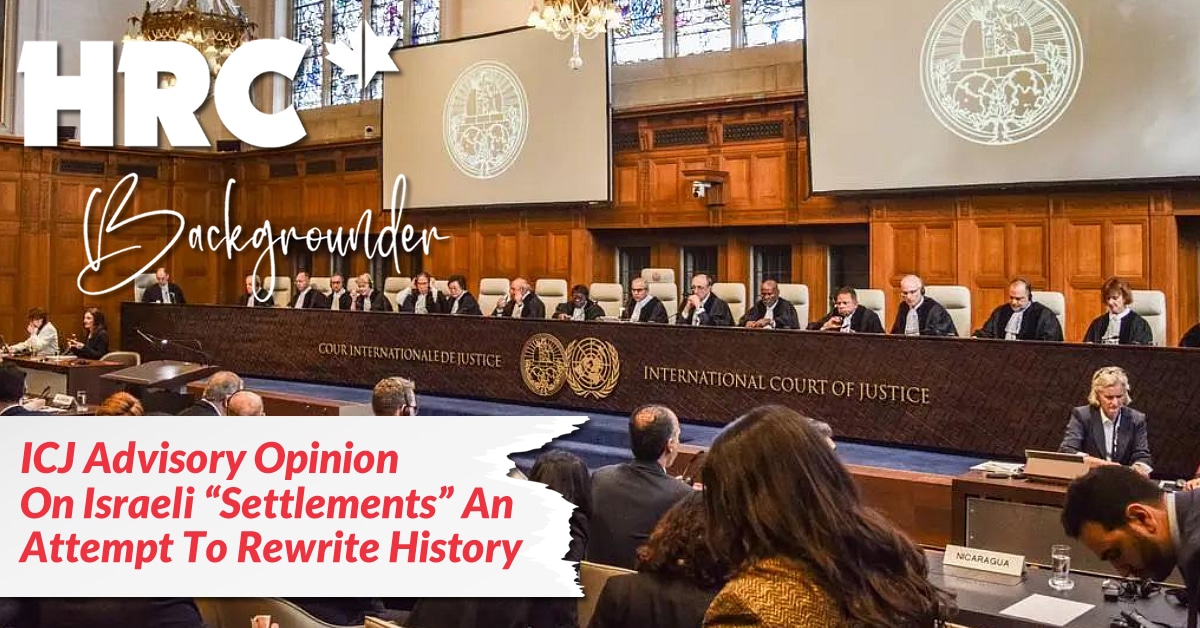
In an advisory opinion that should come as no surprise to any observer of the habitual weaponization of international law by anti-Israel activists, on July 19, the International Court of Justice (ICJ) in The Hague issued a non-binding opinion that called Israel’s presence in the so-called Palestinian territories “unlawful.”
The world court’s new president, Nawaf Salam of Lebanon, referring to Israel as “the regime,” said that Israel’s presence in Judea & Samaria (called “West Bank” by news media outlets) and eastern Jerusalem are a “violation of international law.”
Even before the opinion ruling came out, the result was hardly in doubt. When he served as Lebanon’s ambassador to the United Nations, Salam voted against Israel more than 200 times at the world body and repeatedly voted against every single General Assembly resolution condemning the Islamic Republic of Iran’s abuses against its own population.
Beyond the obvious partiality of the leader of the ICJ, the claim that Israel is an illegal occupier of Palestinian lands is built on an extremely shaky foundation.
The lands in question were won by Israel during the Six Day War in June, 1967 as it defended itself in yet another attempt by its Arab neighbours to destroy the Jewish State. Far from being annihilated, Israel gained territories from its neighbours: the Sinai peninsula and Gaza Strip from Egypt, the strategic Golan Heights plateau from Syria.
Almost 20 years earlier, in 1948, following Israel’s proclaiming its independence, Israel’s neighbour to the east, the Hashemite Kingdom of Jordan, invaded eastern Jerusalem, Judea & Samaria, until it lost those lands in 1967.
None of these territories were acquired from any Palestinian state, for no such country had ever been in existence.
The Sinai Peninsula was returned to Egypt in a 1979 peace agreement, and Jordan relinquished its claims to the territories it had briefly occupied by signing its own peace deal with Israel, in 1994.
As pointed out by noted international law professor Eugene Kontorovich, “under international law, occupation occurs when a country takes over the sovereign territory of another country,” and since Jordan, which had invaded territory in 1948 not its own, was consequently not under Jordanian sovereignty. Furthermore, since in 1994, Jordan effectively relinquished any claims to the lands as part of its peace deal with Israel.
The lands in question were never part of any Palestinian nation-state, for no such state has ever existed in history. The closest that could be claimed is that, as part of the United Nations Partition Plan in 1947, the historic Land of Israel was divided up into a Jewish State, an Arab State, and an international zone for Jerusalem.
But that plan, while accepted by the Jewish parties, was roundly rejected by Arab delegates, which then launched a war of annihilation against Israel in 1948 after the country declared its independence.
And all of this still ignores the most fundamental point: that the Jewish State holds extensive legal title to these lands, both as a result of international law, and because of the three-thousand-year Jewish habitation of the territories. In fact, the word “Jew,” or in Hebrew, “Yehudi,” comes from the land of “Judea.” The Jews are indigenous and assert ownership of that land, and are not occupiers, no matter how much groups like Hamas, the Islamic Republic of Iran, and their useful allies, such as the International Court of Justice, seek to rewrite history to suit their ideological purposes.


